
On the Road (Again)

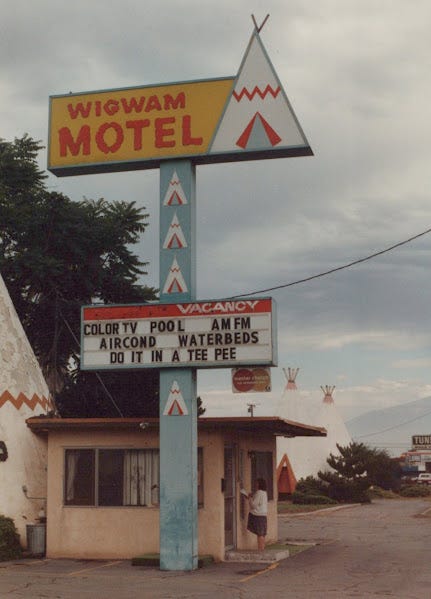
I never travelled on Route 66 when it was a fully functioning highway. Having been born after 66’s heyday, when I started driving patches of it in the mid-80s out in California, it was a disfigured mythical relic. The kitschy and culturally inappropriate Wigwam Motel in San Bernardino that once lured families to “SLEEP IN A TEE PEE,” now lured whatever fringe people still drove this decayed road with the promise to “DO IT IN A TEE PEE.” That didn’t stop me, in fact its seediness was alluring, like we were driving down some post-apocalyptic relic of a bygone era.
Each generation romances some cultural touchstone of the past. For my parent’s generation, they were taken by the Ex-Pats, those American writers and artists disillusioned by their provincial country and fleeing to Paris. There were the Hemingway’s, scraping together whatever francs they had left in their pockets to nurse a coffee for hours with the other intellectual elites at Les Deux Maggot. Or if they were flushed with money, getting drunk at the Ritz like F. Scott and Zelda.
For me, I zagged the other way, feeling the restlessness of Kerouac and the Beats. Despite it being forty years since On the Road had been published, my friends and I gravitated towards the open road in our twenties and headed to rural America, where outsiders and working-class folk were the real angels. Our roadmap was this simple exchange between the main characters, Sal and Dean.
“Sal, we gotta go and never stop going ‘till we get there.’
‘Where we going, man?’
‘I don’t know but we gotta go.”
—Jack Kerouac, On the Road
Recently, on a cross-country trip, I had become bored with all my playlists, so I queued up the audio book of On the Road, hoping to revisit an old friend. An hour into it, I realized I wasn’t going to be rekindling some old friendship. Rather, I might have just picked up an unwanted hitchhiker. Revisiting On the Road wasn’t like picking up where we left off decades before. It was like returning to your high school reunion, where you knew instinctively you shouldn’t have rsvp’d.
I imagine if I had gone to any of these reunions, I’m sure there would be talk of the multitude of drinking games we played, illicit substances we took on any given Saturday night, and remembering those who didn’t make it out alive. After some awkward small talk, someone would be tasked to “get the party started” and play some music that we’d all like. Undoubtably, it would be some moldy rock classic. Truth be told, I left most of my rock albums behind at college or sold them off. 40 years later, those rock singers we once idolized are now getting hip replacements, replacing their heroin addictions for heart medication, and comparing pamphlets on the best assisted living facilities. Still, some joker at the high school reunion would undoubtedly scream out, like he always did at the school dance, “Play Freebird!”
Where I listened to my instincts to never return to my high school reunion, a few hours into the audio book, I realized you can never go back. You’d think I’d be sad—like finding your favorite faded jean jacket from your 20s in the back of a closet, only to realize how thread-bare it had become, and still stinking of cigarettes, pizza and beer. But these revelations don’t bum me out. In fact, it’s freeing to put many cars’ lengths between myself and that book.
Yes, I still marveled at Kerouac’s free style exuberance. You can hear him madly typing away when you read it, high on Benzedrine, and manically trying to capture the urgency of the moment on endless rolls of paper. He tasked himself to leave himself open to America, turning over every stone and celebrating both the mud and the beauty. His immediacy to go out and find America and himself inspired generations of young people to do just that.
Despite his noble aspirations, Kerouac was just human, and his book is riddled with his shortcomings. His misogyny has been well discussed amongst his critics, where women are barely characters; well besides sometimes being underage, others being cheated on, and even one of them being hit. Black characters are more like idolized caricatures too. They’re given an embarrassing adoration, stuck up on some high pedestal like all-knowing street-smart priests of jazz, not flesh and blood humans who go to the toilet like the rest of us. While Black folk are idolized, the gay characters are quickly degraded, with Kerouac dismissively calling them “fags” throughout. And all the while, there is no mention that some of the Beats were gay, while others were bisexual, including some critics saying Kerouac was himself.
But the most regrettable part of the book at times was the main characters themselves, Sal and Dean. On my first reading in college, Dean came off as some heroic methamphetamine angel, some kind of brilliant Icarus. Now revisiting the book, Dean seems more like Kramer from Seinfeld. As I listen, I hear Elaine’s perfect summation of Kramer in my head as he once again botches something.
“You stupid, hipster doofus!” Elaine screams at Kramer then pushes him.
I too wanted to scream “hipster doofus” at Dean with his half-baked truths, and with his continual and impulsive shouts of “Yass! Yass! Yass!” and “Wow!” What I once saw as fits of brilliance in Dean, it now comes off as untreated mental illness. And not only do I want to shout at Dean, but I wanted to scream at Sal too with his blind admiration for his friend. I don’t know why Sal just doesn’t open the car door and push Dean out at times. I would have certainly kicked open that door.
My point here isn’t to throw shade on On the Road. It brought a sea of change, a landmark book of its time, changing my mind and the minds of millions of other young Americans. While Kerouac might of fell short of this himself, bogged down with his confused and convoluted views on women, the gay community and people of color, there is some hidden truth in his shortcomings. Listening to it now, his human imperfections are somehow the point. They add a much-needed dimension to the book’s lofty aspirations—the aspiration to live life fully engaged, while leaving yourself open to the wonders of the world. This is certainly a worthy pursuit no matter the time, and no matter how many times you stumble.
My point is, life is imperfection and change. Everything is fluid, and hopefully, everything is evolving. (Well, not so much these days where that pendulum seems to be out-of-order, or that it’s taking its sweet damn time to swing back.)
The point is you don’t have to hold on to the past and keep asking the band to play “Freebird” decades later. Everyone has moved on, and that’s ok.